
Microsoft Launches Seven MAI Models for Reasoning, Coding, Voice, Images, and Transcription
Microsoft AI Cloud Copilot and Enterprise Technology
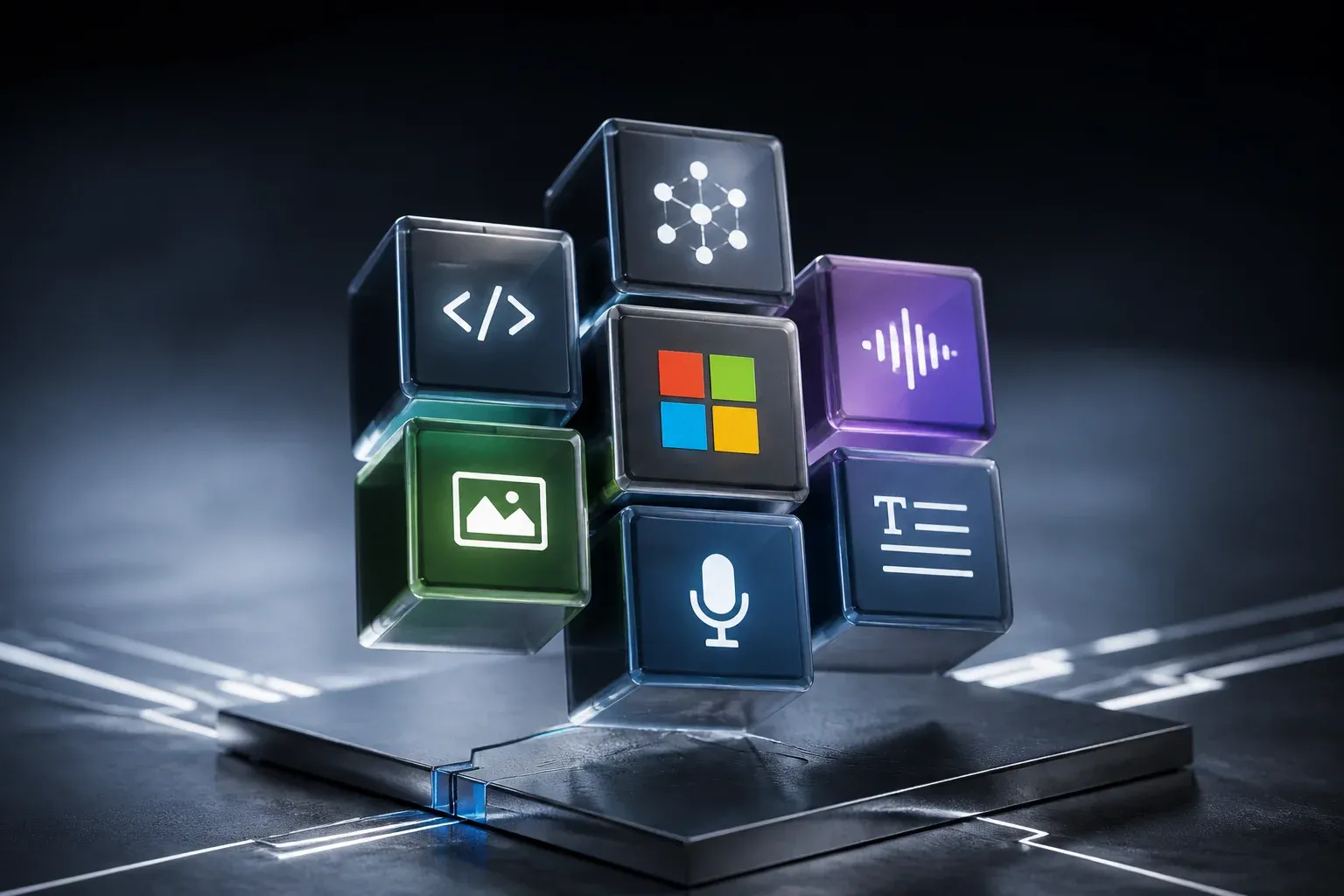
Microsoft AI has launched seven in-house MAI models spanning reasoning, coding, image generation, transcription, and speech. The June 2, 2026 announcement is more than a single model release: Microsoft is positioning MAI as a connected model family, with shared infrastructure, distribution through its own platform and external providers, and a workflow-focused tuning approach for customers.
According to Microsoft AI's official MAI model announcement, the models are built from scratch rather than distilled from third-party models. Microsoft says they share infrastructure and enterprise-grade data lineage, and are intended to work together across its ecosystem. The company also plans availability through Microsoft Foundry and first-party products, with broader developer access through OpenRouter, Fireworks, and Baseten.
For businesses, the notable development is the breadth of the family. Rather than treating text, code, audio, and images as isolated AI purchases, the MAI lineup points toward workflows that can combine several modalities. The practical value will depend on the eventual availability, integration options, and costs for each channel, none of which were detailed in the announcement.
What Microsoft launched
Microsoft identified a set of MAI models for different tasks, including a flagship reasoning model, an efficient coding model, image models, a transcription model, and a voice model. Some Flash variants are designed for efficiency, while the announced MAI-Voice-2-Flash is described as coming soon.
The disclosed MAI model family
The announcement names the following models and capabilities:
- MAI-Thinking-1: Microsoft's flagship reasoning model.
- MAI-Code-1-Flash: an inference-efficient coding model integrated with GitHub Copilot and Visual Studio Code.
- MAI-Image-2.5: an image model, with a Flash variant positioned for ultra-efficiency.
- MAI-Transcribe-1.5: a transcription model that Microsoft says supports high-accuracy transcription across 43 languages.
- MAI-Voice-2: a multilingual speech-generation model that can adapt a voice from short samples.
| Model or variant | Primary role | Notable detail disclosed by Microsoft |
|---|---|---|
| MAI-Thinking-1 | Reasoning | Described as Microsoft's flagship reasoning model |
| MAI-Code-1-Flash | Code generation | Inference-efficient and integrated with GitHub Copilot and Visual Studio Code |
| MAI-Image-2.5 and Flash variant | Image generation | Flash variant is positioned for ultra-efficiency |
| MAI-Transcribe-1.5 | Speech transcription | High-accuracy transcription across 43 languages, according to Microsoft |
| MAI-Voice-2 and upcoming Flash variant | Speech generation | Multilingual voice generation and voice adaptation from short samples |
Distribution and Frontier Tuning
Microsoft says MAI models will be available on Microsoft Foundry and optimized for first-party products. It also says developers will have broad access through OpenRouter, Fireworks, and Baseten, including the ability to tune model weights themselves.
The more distinctive element is what Microsoft calls Frontier Tuning. The company describes it as reinforcement learning in real-world environments, allowing customers to train models on their own workflows within their own environments while retaining ownership of the fine-tuned models. That is a different proposition from simply prompting a general-purpose assistant: it is aimed at making a model behave more effectively in a specific operating context.
Microsoft cited its collaboration with Mayo Clinic as an example. The companies are developing a frontier AI healthcare model that is intended to operate first within Mayo Clinic's environment before becoming available through Foundry to other organizations. The announcement does not provide further implementation details or a release schedule for that model.
What the MAI launch could mean for businesses
The immediate takeaway is not that every organization should adopt every MAI model. It is that Microsoft is building a family that could support connected workflows across common business inputs: documents and calls, internal knowledge, software code, marketing assets, and customer-facing audio.
A smaller team might evaluate the family through specific operational problems rather than model names. Potential use cases supported by the announced capabilities include:
- Transcribing multilingual calls or interviews for searchable records and follow-up work.
- Generating voice content where multilingual speech and controlled voice adaptation are relevant.
- Using coding assistance in GitHub Copilot and Visual Studio Code for development work.
- Producing image assets where MAI-Image-2.5 fits an existing creative workflow.
- Applying workflow-specific tuning where a repeatable process has enough real-world feedback to train against.
The ROI case should remain grounded in the process being improved. Transcription can be measured through time saved on notes and retrieval. Coding assistance can be assessed through delivery speed and review quality. A tuned model should be evaluated against a defined workflow outcome, not just an impressive demonstration. Microsoft has not announced pricing in the supplied materials, so businesses cannot yet calculate a complete cost comparison from this launch alone.
There are also practical unknowns. The announcement sets out distribution plans but does not specify when each model will be accessible through each channel, how each model will be priced, or what implementation requirements will apply. Teams should therefore separate confirmed capabilities from their own assumptions about deployment, performance, and cost.
For companies already using Microsoft tools, MAI-Code-1-Flash has the clearest named integration through GitHub Copilot and Visual Studio Code. For other use cases, Microsoft Foundry and the named developer platforms are the channels to watch as the company turns its distribution plan into available services.
The opportunity is strongest when AI is attached to a clear workflow, reliable inputs, and a measurable outcome. Scalevise helps businesses turn promising model releases into practical implementation plans, from selecting the right use case to connecting tools and defining success measures. A focused AI adoption and implementation consultation can identify where reasoning, transcription, voice, or coding AI can reduce manual work without creating an unnecessary technology project. Request a consultation to assess your highest-value AI workflow.
Frequently Asked Questions
What are Microsoft's MAI models?
Microsoft's MAI models are an in-house family of AI models for reasoning, coding, image generation, transcription, and speech generation.
Which MAI model is integrated with GitHub Copilot and Visual Studio Code?
Microsoft says MAI-Code-1-Flash is integrated with GitHub Copilot and Visual Studio Code.
What is Frontier Tuning?
Microsoft describes Frontier Tuning as reinforcement learning in real-world environments that lets customers train models on their own workflows within their own environments while retaining ownership of the fine-tuned models.
Where does Microsoft plan to make MAI models available?
Microsoft says MAI models will be available on Microsoft Foundry and optimized for first-party products, with broader developer access planned through OpenRouter, Fireworks, and Baseten.
Conclusion
Microsoft's seven-model MAI launch establishes a broader in-house AI portfolio across several business-relevant modalities. Its long-term significance will depend on how Microsoft delivers availability, pricing, integrations, and workflow-specific tuning in practice. For now, the clearest approach for businesses is to match the announced capabilities to concrete processes where time savings, quality, or delivery speed can be measured.
About the author
- Founder of Scalevise. 15+ yrs in automation, AI integration & scalable web architectures. Helping companies streamline operations with custom tools & agents.
Comments
Join the discussionNo comments yet. Be the first to comment.